Why in the hell isn't this working?!
You don't want more updates, more KPIs, more metrics, or more excuses.
You want evidence. You want clarity. And you want to know you can pull this off.
2ndSys shows you how work moves through your organization—where it stalls, where problems spread, how information travels, where decisions get stuck, and how the system adapts when things change.
See for yourself.
We'll show you how work gets done—or doesn't—in one of your systems. For free.
No gimmicks. No upsells.
See why it isn’t workingYour org chart isn't how work gets done.
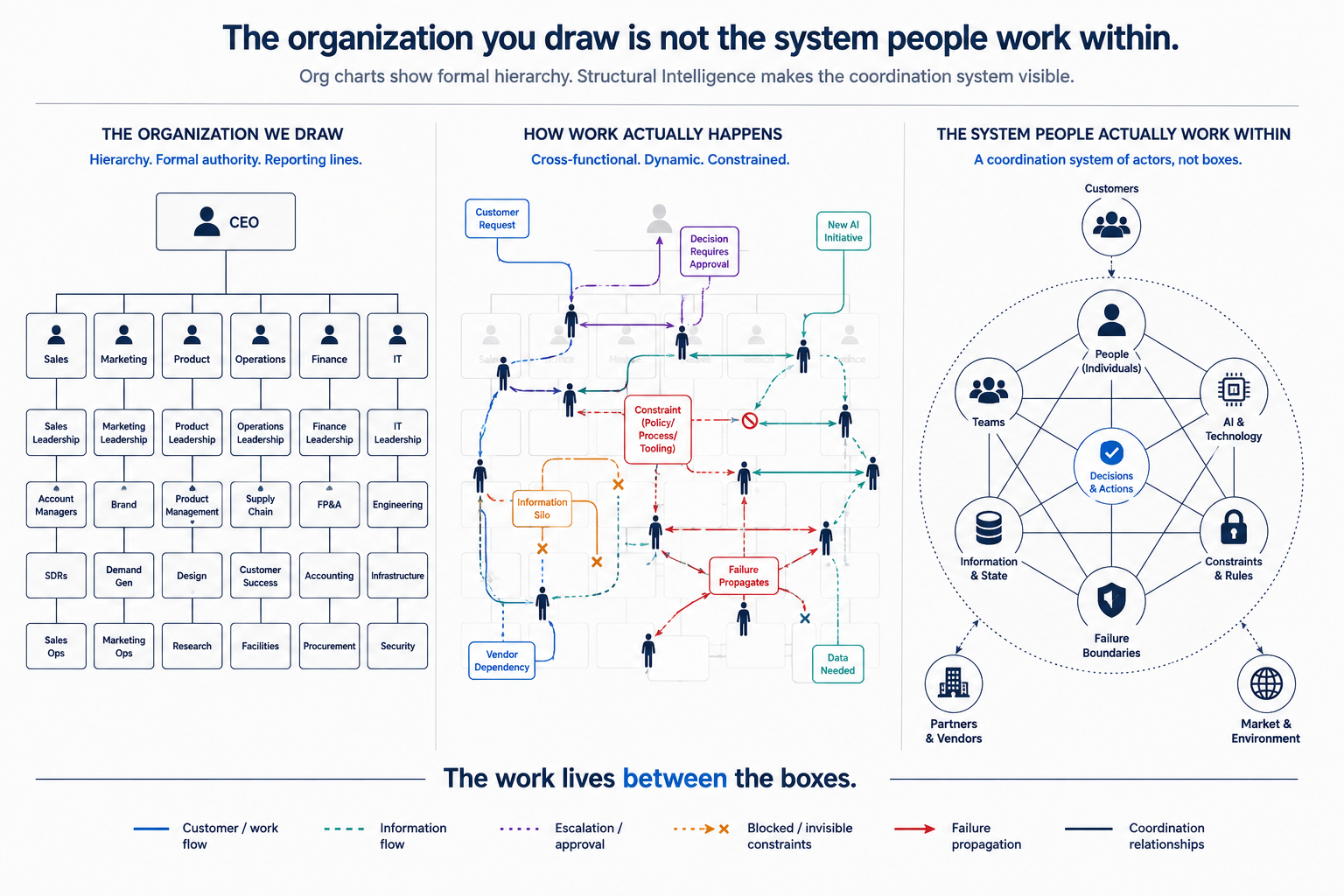
Functions organize people and capability. Work moves across them.
The people, technology, decisions, information, and dependencies involved in moving consequential work from intent to outcome form a system of their own.
That's the system 2ndSys follows.
I can tell this isn't working the way it should.
Every damn decision ends up with leadership.
Why can't people make the decisions they need to make?
Work keeps getting stuck between teams.
Everyone is doing their part. Why does the whole thing keep stalling?
We keep fixing the same problems.
We solve it. It comes back. We solve it again.
Growth was supposed to make us better.
Why did it make everything harder?
Now see what it looks like.
Start with a consequential piece of work: something your organization needs to move from intent to outcome. Give us the people who actively participate in making it happen.
2ndSys makes the coordination system visible and examines how its structural conditions support—or inhibit—the flow of work.
You can see the problem. Do you want help changing it?
Once you can see what is preventing the outcome, you can decide what actually needs to change instead of asking people to compensate for the same problem again.
Establish structural evidence.
See the system producing the work, not merely the symptoms it creates.
Intervene where the evidence points.
Authority. Information. Technology. Capability. Sometimes the Actors themselves.
Determine whether it changed.
Different organization on paper isn't enough. The system has to change in practice.
Or maybe nothing is broken. Yet.
You're about to ask the organization to do something different. Maybe something hard.
There's real money behind it. Expectations have been set. And eventually someone is going to ask whether it's working.
Because the best time to discover a structural problem is before you've bet the outcome on it.
Every person you hire changes the system.
Hiring is usually treated as a question about the candidate: Can they do the job? Do they have the experience? Are they a good fit?
2ndSys.Hire adds a different question: What happens when this person joins this system?
This is Structural Intelligence.
Your organization produces more data than ever. Most of it tells you what is happening—or what has already happened.
Financials. KPIs. Customer data. Employee surveys. Project status. Operational metrics.
How decisions move. How information travels. Where work gets constrained. How problems propagate. How the system adapts.
Evidence about the systems through which your organization gets work done—and how those systems change over time.
Why does this keep coming back to me?
The initiative has an owner. Your leaders know their jobs. The work is underway. And somehow the unresolved decisions, dependencies, conflicts, and constraints keep finding their way back to you.
Keep the accountability. Lose the burden.
A 2ndSys Chief of Structural Change represents you through the structural work surrounding the outcome. Your people keep doing the work. Your leaders keep leading. You get pulled back in when your authority or judgment is actually required.
Better work requires better systems.
Every organization needs capable people. But asking people to compensate indefinitely for structural problems creates frustration, heroics, burnout, and avoidable failure.
2ndSys exists to improve the human experience of work by improving the coordination systems people work within.
Stop guessing. Collect evidence.
Start with one system that matters. See what is actually happening underneath the work.